
Dreaming about mask
Masks are reported for one reason: they remove a face that the dreamer needs to read. The unease they produce is the same unease the faceless-person reports describe, and the two belong together.
Also searched as: masks, a masked person, wearing a mask, face covered

Being unable to read intent is the whole content. Dreamers describe a masked figure whose posture and behaviour give nothing away, and report unease disproportionate to anything happening.
A distinct and more disturbing group involves the dreamer wearing one and being unable to remove it. These reports carry suffocation as well as concealment, and the breathing element is worth checking.
Masks that are the wrong way round, or that are a face rather than covering one, appear in a small number of reports and are described as the worst version.
Removal reports are notable: dreamers frequently describe the mask coming off and there being nothing, or another mask, underneath.
Common associations
- A face that cannot be read, shared directly with the faceless material.
- Concealment as an act, rather than as an accident.
- Suffocation, in the wearing reports.
- Ritual and role, in the traditions.
Positive readings
Some dreamers report masks in a celebratory or performative register, usually with a carnival or theatre setting, and those reports are lively rather than uneasy.
Where the mask is one the dreamer chooses and can remove, the reports are neutral.
Difficult readings
The unremovable mask is genuinely distressing and combines two aversive elements. Where breathing is involved, the same physical checks the drowning entry lists apply.
Nothing underneath is the most disturbing reported version and belongs with the doppelganger and faceless material.
Psychological perspectives
A threat system reads faces first, and a mask defeats that directly. The response is not to the mask but to the absence of information, which is why nothing has to happen for the dream to be unpleasant.
That structure recurs across a large group of entries here: the lizard, the faceless person, the watcher. It may be the single most productive source of dream unease that contains no actual threat.
The wearing version needs a separate account and probably has a physical one, given how often breathing is mentioned.
Cultural and historical
Masks in ritual are not disguises in most traditions that use them. They are frequently understood as making something present rather than hiding someone, which is close to the opposite of the modern Western reading.
Theatrical masks and the idea of the persona come through the Greek and Roman theatre and into modern psychology as a term.
The disguise reading is the shallowest of the three available, and it is the one most dream dictionaries use.
What the sleep science says
Reasonably supported: face and gaze processing are highly salient in dream content, and their absence sustains unease.
Worth checking: breathing during sleep, where the wearing version recurs.
Not established: any meaning for the mask itself.
Your own context
- Were you wearing it or facing it?
- Could it come off?
- What was underneath?
- Could you breathe?
If this recurs
Log with the faceless-person and doppelganger reports rather than as an object, because the discomfort is the same one and the group moves together.
Emotions often reported
- unease
- dread
- panic
- confusion
- alarm
- revulsion
Specific mask dreams
Each of these is written separately, not generated from this page.
What happened
What state it was in
Questions for reflection
These are for your journal, not for us. Nothing you write is shared.
- Was I wearing it?
- Did it come off, and what was there?
- Was my breathing all right?
Dream interpretation is subjective. Nothing here is a diagnosis, a prediction, or medical advice.
Sources and reviewed references
4 references. What these labels mean
- 1.The Reinterpretation of Dreams: An Evolutionary Hypothesis of the Function of DreamingPeer-reviewed research
Antti Revonsuo (2000) · Behavioral and Brain Sciences
Cited for: The threat-simulation hypothesis. That the over-representation of threatening content in dreams may be functional rather than incidental.
- 2.The Scientific Study of Dreams: Neural Networks, Cognitive Development and Content AnalysisAcademic book
G. William Domhoff (2003) · American Psychological Association
Cited for: The continuity hypothesis (that dream content largely reflects waking concerns) and a sustained critique of symbolic dream interpretation as an evidential method.
- 3.Man and His SymbolsPsychology literature
Carl Jung and others (1964) · Aldus Books
Cited for: The amplification method, the compensatory function of dreams, and the archetypal reading of recurring figures such as the shadow.
- 4.The Content Analysis of DreamsAcademic book
Calvin Hall and Robert Van de Castle (1966) · Appleton-Century-Crofts
Cited for: The standard coding system for dream content, and the normative frequencies that later studies are compared against. The reason claims like "aggression is more common in dreams than friendliness" can be stated numerically at all.
Dreamers’ accounts
How dreams of mask have gone for other people, in their own words. Nothing here is an interpretation of anyone else's dream. It is a record of what happened and what it was like.
Nothing here yet. Be the first to say how this has gone for you.
Related records
- PersonStrangerUnknown figures make up a large share of dream characters. Most are scenery. The ones worth a note are the ones the dreamer felt something specific about, without being told anything.
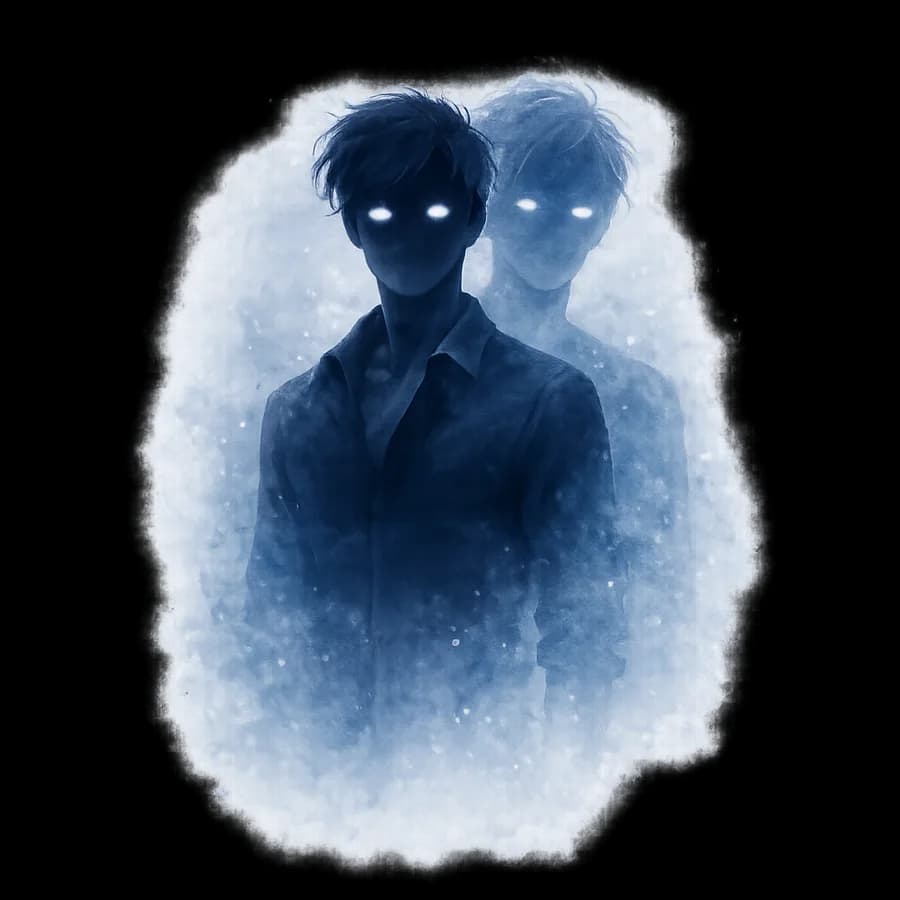
- PersonFaceless personFaces are one of the things dreaming struggles to hold steady, so a figure without a clear face is common and mechanically unremarkable. It becomes significant when the facelessness is the point, when the dreamer notices and reacts to it.
- SymbolMirrorMirrors in dreams are almost never about vanity. Dreamers overwhelmingly report the reflection being wrong (delayed, aged, a stranger, or absent) and it is the wrongness, not the mirror, that carries the meaning.
- SymbolGrassGrass is almost never the subject of a dream and is reported constantly as ground. Where it becomes the subject, it is because it is too long, and that version carries a specific and quite mild guilt.
- SymbolLetterLetters in dreams are almost never read. The characteristic report is an envelope that is not opened, or is opened and cannot be made out, and the dreamer usually knows who it is from without evidence.
- SymbolMapA map is the worst possible object to hand a dreamer. It is text, it is fine detail, and it claims to describe a space that has no underlying model, so it fails on three counts at once.



Figures people report during these dreams
From the archives, and held to their own evidence standard rather than to the one on this page. Reported alongside mask often enough to be worth naming.
Records that mention mask
These pages link to mask, either as something reported in the same dream or as a related subject. This page does not point back at all of them, so the list is assembled rather than chosen.