
Dreaming about face
Faces are the most attended thing in dream content and the least stable. A face that changes, that will not resolve, or that belongs to the wrong person is among the most reported and most unsettling experiences there is.
Also searched as: my face, a face in a dream, my face changed, someone elses face, no face

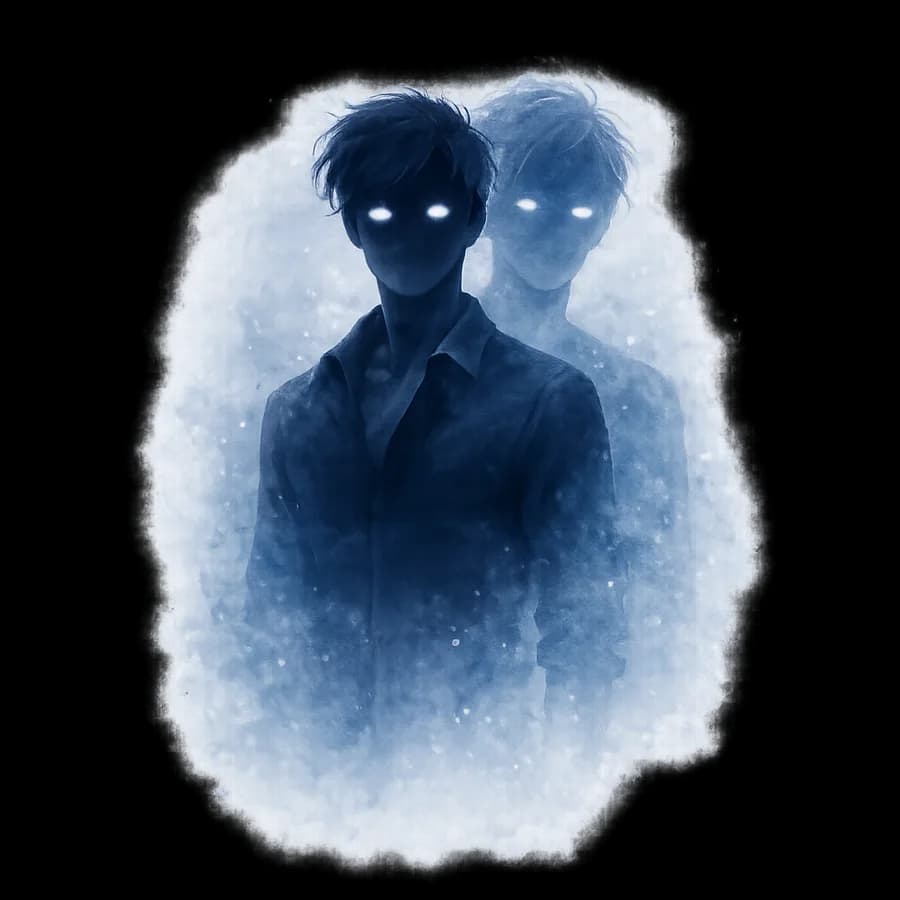
Instability dominates. Dreamers describe a face shifting while they look, or being unable to hold it in view, or knowing who somebody is while their face says otherwise.
Seeing your own face is a distinct group and is nearly always in a mirror, where the mirror entry applies and the reflection is frequently wrong.
A face with no features belongs with the faceless-person material and produces the same unresolvable unease as masks and dolls.
Recognising somebody without their face matching is reported very often and is one of the clearest demonstrations that dreams supply identity separately from appearance.
Common associations
- Identity held apart from appearance, which is the central finding.
- Instability under attention.
- Absence of features, in the faceless reports.
- Your own face, in the mirror ones.
Positive readings
Faces are among the more reliable reality checks after hands and text, because a second look so often returns something different.
The identity finding is genuinely interesting on its own terms and dreamers frequently enjoy learning it.
Difficult readings
A changing face is disturbing in a way dreamers find hard to convey, and a face that will not resolve is worse.
Where the face belongs to somebody who has died, or to a person the dreamer cannot place, the reports carry more weight and belong with the grief and stranger material.
Psychological perspectives
Face processing is highly specialised and highly attended, so a dream face is under more scrutiny than anything else in the scene, and its failure to hold up is correspondingly obvious.
The identity finding is the more important one. Dreams assert who somebody is directly, and the face is generated separately and optionally, which is why the two can disagree without the dreamer objecting.
That single fact explains the wrong-face reports across this entire database, from partners to strangers to the dead.
Cultural and historical
Faces carry enormous social and ritual weight everywhere, and masks in ritual are frequently understood as making something present rather than concealing a person, which the mask entry covers.
The idea of a true face behind a presented one is available in several traditions and in modern psychology as a metaphor, and dreamers reach for it readily.
What the sleep science says
Well documented: faces are unstable in dreams and are used as a reality check.
Reasonably supported: identity in dreams is asserted independently of appearance.
Not established: any meaning in a particular face appearing.
Your own context
- Did the face stay the same?
- Did you know who it was regardless?
- Was it your own?
- Could you see features at all?
If this recurs
Log with the mirror, mask and faceless-person reports. They share one mechanism and reviewing them together tends to make it obvious.
Emotions often reported
- unease
- confusion
- alarm
- fascination
- dread
- curiosity
Specific face dreams
Each of these is written separately, not generated from this page.
Questions for reflection
These are for your journal, not for us. Nothing you write is shared.
- Did the face change?
- Did I know who it was anyway?
- Could I make out any features?
Dream interpretation is subjective. Nothing here is a diagnosis, a prediction, or medical advice.
Sources and reviewed references
4 references. What these labels mean
- 1.Lucid Dreaming Verified by Volitional Communication During REM SleepPeer-reviewed research
Stephen LaBerge, Lynne Nagel, William Dement and Vincent Zarcone (1980) · Perceptual and Motor Skills
Cited for: The eye-signalling experiments that established lucid dreaming as a verifiable state rather than a self-report.
- 2.Dreaming: A Conceptual Framework for Philosophy of Mind and Empirical ResearchAcademic book
Jennifer M. Windt (2015) · MIT Press
Cited for: A modern philosophical treatment of what dreams are, including the immersive-spatiotemporal-hallucination account and the status of dream reports as evidence.
- 3.The Scientific Study of Dreams: Neural Networks, Cognitive Development and Content AnalysisAcademic book
G. William Domhoff (2003) · American Psychological Association
Cited for: The continuity hypothesis (that dream content largely reflects waking concerns) and a sustained critique of symbolic dream interpretation as an evidential method.
- 4.Induction of Lucid Dreams: A Systematic Review of EvidencePeer-reviewed research
Tadas Stumbrys, Daniel Erlacher, Melanie Schädlich and Michael Schredl (2012) · Consciousness and Cognition
Cited for: That no induction technique has strong evidence of reliable effectiveness, and that the better-supported ones are cognitive rather than external.
Dreamers’ accounts
How dreams of face have gone for other people, in their own words. Nothing here is an interpretation of anyone else's dream. It is a record of what happened and what it was like.
Nothing here yet. Be the first to say how this has gone for you.
Related records
- SymbolMaskMasks are reported for one reason: they remove a face that the dreamer needs to read. The unease they produce is the same unease the faceless-person reports describe, and the two belong together.
- PersonFaceless personFaces are one of the things dreaming struggles to hold steady, so a figure without a clear face is common and mechanically unremarkable. It becomes significant when the facelessness is the point, when the dreamer notices and reacts to it.
- SymbolMirrorMirrors in dreams are almost never about vanity. Dreamers overwhelmingly report the reflection being wrong (delayed, aged, a stranger, or absent) and it is the wrongness, not the mirror, that carries the meaning.
- SymbolClockClocks in dreams are notoriously unreliable, the time changes when you look twice, and that instability is a well-known feature of dreaming rather than a symbol. Where clocks do carry meaning, it is almost always about lateness.
- SymbolPhotographPhotographs in dreams behave like text: they do not hold still. The most reported version is a picture whose contents change or are wrong, and it is one of the more effective reality checks available.
- SymbolBookBooks are reported almost entirely through the failure to read them, and that failure is one of the few dream phenomena with a solid explanation behind it: text in dreams is genuinely unstable.



Figures people report during these dreams
From the archives, and held to their own evidence standard rather than to the one on this page. Reported alongside face often enough to be worth naming.
Records that mention face
These pages link to face, either as something reported in the same dream or as a related subject. This page does not point back at all of them, so the list is assembled rather than chosen.