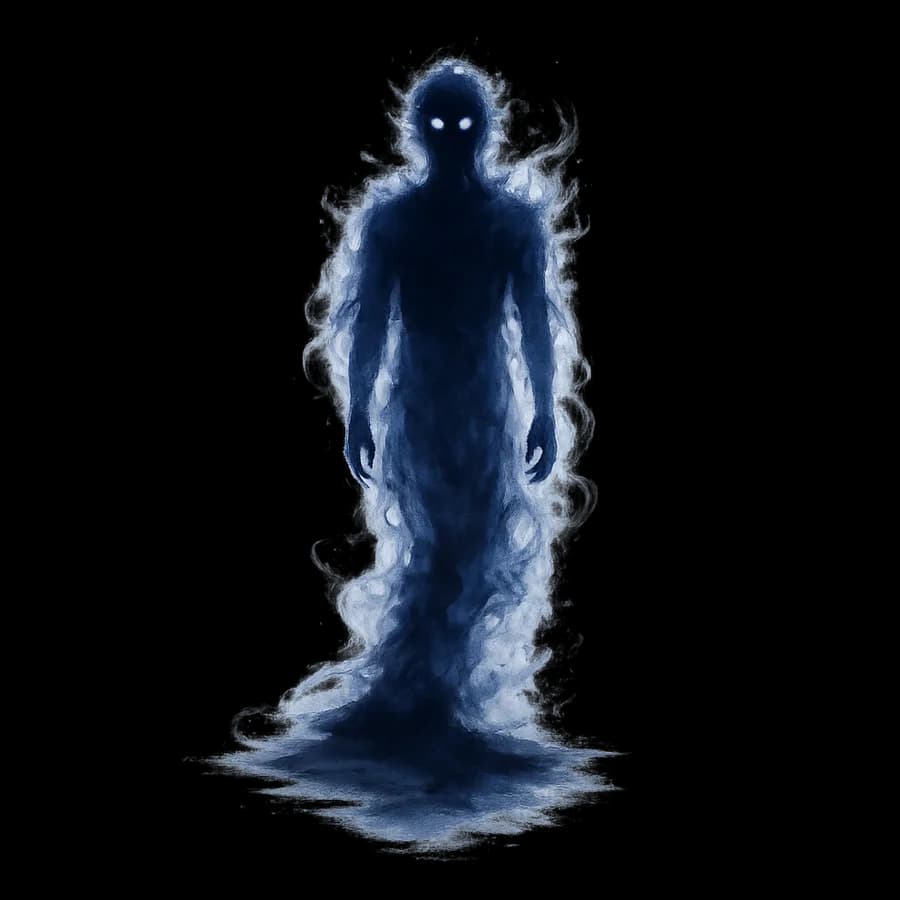
Dreaming about your own shadow
Distinct from the shadow person in the Bestiary, which is a figure. This is the dreamer's own shadow, and it is one of the most reliable consistency failures a dream produces: wrong direction, wrong shape, delayed, or absent entirely.
Also searched as: a shadow, my shadow, a shadow that moved wrongly, no shadow

Mismatch is the report. Dreamers describe a shadow that points the wrong way for the light, moves late, is the wrong shape, or is missing.
That is a consistency failure of exactly the kind dreams cannot avoid, because a shadow has to agree with a body and a light source at once and nothing is tracking either.
Having no shadow is reported and is described as unsettling out of proportion, in the way the empty-chair and empty-playground reports are.
A shadow that acts independently is rare, and where it occurs it belongs with the doppelganger and second-self material rather than here.
Common associations
- A consistency failure, which is what makes it useful.
- Agreement between a body and a light source, which nothing is maintaining.
- Absence, which is worse than wrongness.
- Independence, in the rarer reports.
Positive readings
An excellent and under-used reality check. Look at your shadow, then at the light: a dream will very rarely get both right.
It is available outdoors and indoors and requires nothing.
Difficult readings
The missing shadow produces a specific unease that dreamers find hard to name and remember well.
Otherwise mild.
Psychological perspectives
Dreams do not model illumination, which the sun, gold and candle entries all describe. A shadow is illumination made visible, so it is the place where that limitation shows most cleanly.
That is why the check works: it asks for agreement between two things the dream generated separately and never reconciled.
The unease at absence is the expectation-violation pattern this database records across the empty pool, the eclipse and the silent crowd.
Cultural and historical
A person without a shadow is a specific and recurrent folkloric image, usually indicating that something is wrong with them, and it is widespread enough to be available to most dreamers.
The psychological use of shadow as a name for a disowned part of the self is a twentieth-century framework and is not what these reports describe.
What the sleep science says
Reasonably supported: dreams do not model illumination, so shadows and light sources are generated independently.
Well documented: environmental inconsistency as an effective reality check.
Not established: any meaning for a shadow.
Your own context
- Did it match the light?
- Did it move when you did?
- Was there one at all?
- Did you check?
If this recurs
Build the check. Shadow, light, direction: three seconds, and it fails more reliably than most published reality checks.
Emotions often reported
- unease
- confusion
- curiosity
- alarm
- detachment
- wonder
Specific your own shadow dreams
Each of these is written separately, not generated from this page.
Questions for reflection
These are for your journal, not for us. Nothing you write is shared.
- Did it match the light?
- Was there one at all?
- Did I look?
Dream interpretation is subjective. Nothing here is a diagnosis, a prediction, or medical advice.
Sources and reviewed references
4 references. What these labels mean
- 1.Lucid Dreaming Verified by Volitional Communication During REM SleepPeer-reviewed research
Stephen LaBerge, Lynne Nagel, William Dement and Vincent Zarcone (1980) · Perceptual and Motor Skills
Cited for: The eye-signalling experiments that established lucid dreaming as a verifiable state rather than a self-report.
- 2.Induction of Lucid Dreams: A Systematic Review of EvidencePeer-reviewed research
Tadas Stumbrys, Daniel Erlacher, Melanie Schädlich and Michael Schredl (2012) · Consciousness and Cognition
Cited for: That no induction technique has strong evidence of reliable effectiveness, and that the better-supported ones are cognitive rather than external.
- 3.The Scientific Study of Dreams: Neural Networks, Cognitive Development and Content AnalysisAcademic book
G. William Domhoff (2003) · American Psychological Association
Cited for: The continuity hypothesis (that dream content largely reflects waking concerns) and a sustained critique of symbolic dream interpretation as an evidential method.
- 4.Man and His SymbolsPsychology literature
Carl Jung and others (1964) · Aldus Books
Cited for: The amplification method, the compensatory function of dreams, and the archetypal reading of recurring figures such as the shadow.
Dreamers’ accounts
How dreams of your own shadow have gone for other people, in their own words. Nothing here is an interpretation of anyone else's dream. It is a record of what happened and what it was like.
Nothing here yet. Be the first to say how this has gone for you.
Related records
- SymbolSunThe sun is rarely looked at in dreams and frequently behaves impossibly: in the wrong place, more than one of them, or shining without lighting anything. That misbehaviour is more useful than any reading.
- ActionKnowing you are dreamingLucid dreaming is one of the few things in this entire database that has been demonstrated in a laboratory rather than inferred from reports. Sleepers have signalled from inside a dream with prearranged eye movements, on cue, while verifiably asleep.
- SymbolMirrorMirrors in dreams are almost never about vanity. Dreamers overwhelmingly report the reflection being wrong (delayed, aged, a stranger, or absent) and it is the wrongness, not the mirror, that carries the meaning.
- SymbolAn empty chairThe exception in this file: a chair is not reported through failure but through absence. The empty chair is one of the most quietly affecting images in the database and it belongs with the grief material.
- SymbolBookBooks are reported almost entirely through the failure to read them, and that failure is one of the few dream phenomena with a solid explanation behind it: text in dreams is genuinely unstable.
- SymbolClockClocks in dreams are notoriously unreliable, the time changes when you look twice, and that instability is a well-known feature of dreaming rather than a symbol. Where clocks do carry meaning, it is almost always about lateness.

Figures people report during these dreams
From the archives, and held to their own evidence standard rather than to the one on this page. Reported alongside your own shadow often enough to be worth naming.